

.png)
Annual PPC budget: $240,000. Current management: Founder spending 15 hours weekly running Google Ads, Meta campaigns, and LinkedIn ads. Results: $180,000 revenue generated, 0.75 ROAS (losing $60,000 annually).
Hiring decision: Should we hire full-time PPC manager ($85,000 salary + benefits = $102,000 total) or retain pay per click consultant ($8,000 monthly = $96,000 annually)?
Financial analysis: In-house manager costs $102,000 annually. Consultant costs $96,000 annually. Cost difference: $6,000 favoring consultant.
Expertise analysis: In-house manager brings platform knowledge, learns business context over time, available for daily optimizations. Consultant brings cross-client pattern recognition, current platform updates, specialized vertical experience, but works across multiple accounts.
Three months later: Hired in-house manager. ROAS improved to 1.2 (from 0.75), generating $288,000 revenue on $240,000 spend. Profit improvement: $108,000 gain vs. previous $60,000 loss = $168,000 swing. Manager salary $102,000 justified by $168,000 improvement.
But different scenario reveals opposite conclusion: Company with $60,000 annual ad spend hires $85,000 in-house manager. Even achieving 3.0 ROAS ($180,000 revenue) cannot justify $85,000+ salary when consultant at $3,000 monthly ($36,000 annually) delivers similar results at lower cost relative to spend.
The consultant vs. in-house decision hinges not on absolute cost comparison but on ad spend scale, expertise requirements, optimization frequency needs, and whether specialized knowledge justifies dedicated headcount.
"If you think it's expensive to hire a professional, wait until you hire an amateur." — Red Adair
The Ad Spend Threshold Determining Consultant vs. In-House
Pay per click consultant vs. in-house manager economics change based on monthly ad spend:
Under $20,000 Monthly Ad Spend
Consultant advantages:
Monthly consultant fee: $2,000-4,000 (10-20% of spend)
Access to specialized expertise without full salary
No benefits, payroll taxes, or overhead costs
Can terminate engagement if performance insufficient
In-house challenges:
Manager salary: $75,000-90,000 annually ($6,250-7,500 monthly)
Benefits add 20-30%: Total $90,000-117,000 annually
Manager cost exceeds 37-49% of annual ad spend
Economically unjustifiable unless managing other marketing
Breakeven analysis: At $20,000 monthly spend ($240,000 annually), consultant at 15% = $36,000 annually. In-house manager at $90,000 minimum means manager costs 2.5x consultant fee. Consultant must underperform by 150% for in-house to make economic sense.
$20,000-50,000 Monthly Ad Spend
Transition zone where both models viable:
Consultant model: $3,000-7,500 monthly (15% of spend typical)
In-house model: $90,000-105,000 annually (senior manager level)
Consultant advantages:
Multiple account exposure = faster pattern recognition
No single-company knowledge limitations
Platform beta access through agency relationships
Vertical specialization (ecommerce, SaaS, B2B)
In-house advantages:
Daily optimization availability
Deep product knowledge
Cross-channel integration (SEO, email, content)
No knowledge transfer delays
Decision factors:
Industry complexity (B2B enterprise = favors in-house for sales cycle knowledge)
Platform diversity (managing 5+ platforms = favors specialized consultant)
Testing velocity (10+ tests monthly = benefits from in-house daily access)
Growth trajectory (scaling 2x annually = benefits in-house continuity)
Above $50,000 Monthly Ad Spend
In-house becomes economically favorable:
At $50,000 monthly spend ($600,000 annually):
Senior PPC manager: $105,000-120,000 annually = 17-20% of spend
Consultant at 12%: $72,000 annually
Cost difference narrows to $33,000-48,000
But in-house delivers advantages consultant cannot:
Daily optimization: Testing new ad creative, adjusting bids 2-3x daily based on performance, immediate budget reallocation
Deep attribution: Understanding full customer journey from click to revenue including CRM integration
Product launch coordination: Aligning campaigns with product releases, coordinating with product team on messaging
Cross-functional integration: Working with content team on landing pages, coordinating with sales on lead quality
Research shows teams testing 10+ A/B variations achieve 86% better conversion results. At $50,000+ monthly spend, daily testing access in-house manager provides outweighs consultant cost savings.
What Consultants Bring That In-House Cannot
Despite economic advantages of in-house at scale, consultants provide unique value:
Cross-Client Pattern Recognition
In-house limitation: Manager sees only single company's account performance, testing results, audience behavior
Consultant advantage: Managing 10-30 accounts simultaneously reveals patterns individual accounts miss
Example pattern consultant identifies:
Across 12 ecommerce clients, mobile conversion rates drop 40% when checkout requires account creation. In-house manager at single company might test account requirement once, see 15% drop, conclude minor issue. Consultant seeing pattern across clients immediately implements guest checkout, improving mobile conversion 35-45% consistently.
Pattern recognition value: Consultant testing variation across multiple accounts identifies winning approaches 3-4x faster than in-house manager testing sequentially at single company.
Platform Beta and Update Access
Consultant advantage: Agency partnerships with Google, Meta, Microsoft provide:
Early beta access to new features (Performance Max, Advantage+ Shopping)
Dedicated platform support (30-minute response vs. 72-hour standard)
Training on algorithm updates before public announcement
Account rep relationships enabling issue escalation
In-house limitation: Standard support tier, public feature rollout timing, no dedicated account rep unless spending $100,000+ monthly per platform
Value quantification: Early Performance Max access (3 months ahead of public rollout) enabled consultant clients to optimize campaigns during low-competition period, achieving 25-30% better ROAS before broader adoption increased competition.
Vertical Specialization
Consultant advantage: Focusing exclusively on single vertical (SaaS, ecommerce, B2B) develops specialized knowledge:
Audience targeting patterns by vertical
Offer structures that convert in category
Ad creative formats performing in niche
Landing page elements specific to buyer psychology
Example specialization value:
SaaS PPC consultant knows enterprise buyers research 3-6 months before purchase, optimizes campaigns for long consideration cycles, tracks assisted conversions not just last-click. Generalist in-house manager might optimize for immediate conversions, missing 70% of actual influenced revenue.
Fractional Expertise Access
Consultant model enables accessing multiple specialists:
Google Ads specialist + Meta specialist + LinkedIn specialist at combined $6,000 monthly
Each brings platform-specific depth
Total cost less than single generalist in-house manager
In-house limitation: One manager must cover all platforms, spreading expertise thin across Google Ads, Meta, LinkedIn, Microsoft, Amazon, TikTok.
What In-House Brings That Consultants Cannot
In-house managers provide advantages consultants structurally cannot match:
Deep Product and Customer Knowledge
In-house advantage: Daily exposure to product roadmap, customer support tickets, sales calls, user research
Consultant limitation: Surface-level product knowledge, quarterly business reviews, limited customer interaction
Knowledge application example:
In-house manager attends customer research sessions, learns prospects abandon during trial when feature X fails. Immediately adjusts PPC targeting away from use cases requiring feature X, reducing trial-to-paid conversion waste 30%. Consultant lacking this context continues driving traffic to weak use cases.
Cross-Channel Integration
In-house advantage: Direct collaboration with SEO, content, email, product teams
Consultant limitation: Siloed PPC management, limited cross-channel visibility
Integration value:
In-house manager coordinates with content team: identifies high-converting PPC keywords, requests SEO content targeting same keywords, creates retargeting campaigns for blog readers. Integrated approach reduces PPC dependency, improves blended CAC 35%. Consultant managing only PPC misses integration opportunity.
Daily Optimization Availability
In-house advantage: Available for immediate optimizations:
Product launch announced → campaigns updated within 2 hours
Competitor price drop detected → bidding strategy adjusted same day
Landing page A/B test wins → traffic shifted within hours
Budget windfall approved → scaling implemented immediately
Consultant limitation: Weekly optimization cycles, 24-48 hour response times, scheduled check-ins
Timing value: Flash sale opportunity identified morning of event. In-house manager launches campaigns within 3 hours, captures 40% of demand. Consultant on weekly schedule misses opportunity or responds too late.
Attribution and Reporting Control
In-house advantage: Direct CRM access, revenue data visibility, full-funnel attribution
Consultant limitation: Reports metrics client provides, limited system access, surface-level attribution
Example limitation:
Consultant optimizes for "conversions" defined as form submissions. In-house manager with CRM access discovers 60% of form submissions never become sales calls due to poor qualification. Adjusts targeting to quality over volume, reducing cost per actual customer 50%. Consultant lacking CRM visibility cannot make this optimization.
The Hybrid Model: Consultant + Junior In-House
Companies at $30,000-70,000 monthly spend increasingly adopt hybrid approach:
Structure:
Senior PPC consultant: $4,000-6,000 monthly (strategy, platform expertise, optimization recommendations)
Junior in-house coordinator: $50,000-65,000 annually (execution, daily monitoring, internal communication)
Total cost: $98,000-137,000 annually
Advantages over pure in-house:
Access to senior expertise at consultant level
Daily execution from in-house coordinator
Combined cost similar to single senior in-house manager
But delivers both strategic depth and tactical speed
Advantages over pure consultant:
In-house coordinator provides product knowledge consultant lacks
Daily monitoring consultant cannot deliver
Internal communication reducing response delays
Knowledge retention if consultant relationship ends
Hybrid execution workflow:
Consultant responsibilities (8-12 hours monthly):
Monthly strategy sessions reviewing performance
Quarterly campaign restructuring
New platform feature evaluation and implementation
A/B testing prioritization and analysis
Competitive landscape monitoring
In-house coordinator responsibilities (full-time):
Daily bid adjustments within consultant-set parameters
Ad creative production and launch
Landing page A/B test coordination
Budget pacing monitoring
Internal stakeholder reporting
Cross-functional meeting attendance
Hybrid model performs best when:
Ad spend $30,000-70,000 monthly (justifies coordinator salary plus consultant)
Platform complexity high (5+ active platforms)
Testing velocity important (10+ tests monthly)
Internal coordination critical (frequent product launches, sales alignment needs)
The Decision Framework
Pay per click consultant vs. in-house choice follows systematic evaluation:
Factor 1: Ad Spend Scale
Under $20,000 monthly: Consultant economically superior (cost 10-20% of spend vs. manager 37-49%)
$20,000-50,000 monthly: Transition zone, evaluate other factors
Above $50,000 monthly: In-house economically viable (cost 17-20% of spend)
Factor 2: Expertise Requirements
Generalist needs (Google Ads + Meta basics): In-house manager sufficient
Specialist needs (Performance Max optimization, B2B LinkedIn, ecommerce feed management): Consultant specialization valuable
Multi-platform needs (5+ platforms): Consultant platform breadth or hybrid model
Factor 3: Optimization Frequency
Weekly optimization acceptable: Consultant sufficient
Daily optimization important: In-house or hybrid
Real-time optimization critical (flash sales, time-sensitive promotions): In-house required
Factor 4: Product Complexity
Simple product (single SKU, clear value prop): Consultant can manage with quarterly briefings
Complex product (enterprise software, custom configurations): In-house product knowledge critical
Rapidly evolving product (weekly releases): In-house coordination essential
Factor 5: Growth Trajectory
Stable spend ($30,000 monthly consistent): Either model works
Rapid growth (2x annually): In-house provides continuity, institutional knowledge
Uncertain growth: Consultant provides flexibility, no long-term commitment
Factor 6: Internal Resources
No marketing team: Consultant provides full-service management
Established marketing team: In-house integrates better with SEO, content, product
Junior marketing team: Hybrid model provides senior expertise + internal coordination
Cost Comparison: 12-Month Total Investment
Economic comparison requires accounting for full costs:
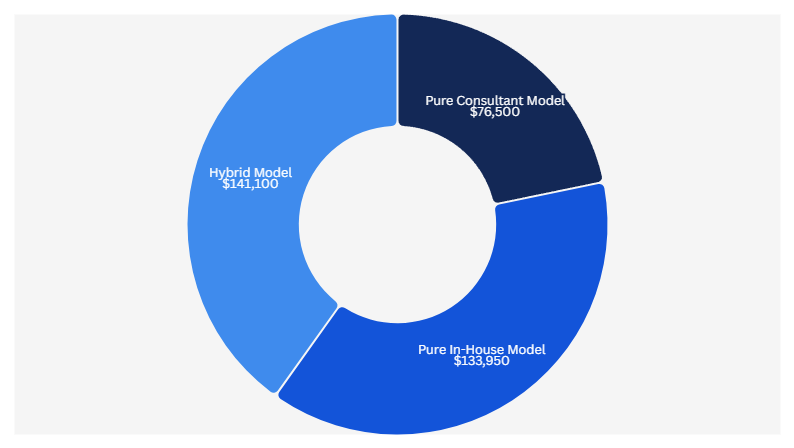
Pure Consultant Model
Consultant fee: $6,000 monthly ($72,000 annually)
Internal coordination time: 5 hours monthly at $75/hour opportunity cost ($4,500 annually)
Platform and tool costs: $3,600 annually (consultant typically includes)
Total investment: $76,500 annually
Advantages: No benefits, no recruiting costs, no management overhead
Risks: Knowledge leaves with consultant, potential service degradation, limited platform access
Pure In-House Model
Manager salary: $95,000 annually
Benefits (health, 401k, payroll tax): 25% = $23,750
Recruiting costs: $8,000 (one-time)
Platform and tool subscriptions: $3,600 annually
Management overhead: 2 hours monthly at $150/hour = $3,600
Total first-year investment: $133,950
Advantages: Full control, product knowledge depth, cross-functional integration
Risks: Single perspective, knowledge gaps, limited platform relationships
Hybrid Model
Senior consultant: $5,000 monthly ($60,000 annually)
Junior coordinator salary: $58,000 annually
Coordinator benefits: 25% = $14,500
Recruiting costs: $5,000 (coordinator level, one-time)
Tools and platforms: $3,600 annually
Total first-year investment: $141,100
Advantages: Senior expertise + daily execution + product knowledge
Risks: Coordination complexity, highest total cost, two-party dependency
ROI Comparison at Different Spend Levels
$20,000 monthly ad spend ($240,000 annually):
Consultant model: $76,500 cost = 31.9% of spend
In-house model: $133,950 cost = 55.8% of spend
Winner: Consultant (saves $57,450 annually)
$50,000 monthly ad spend ($600,000 annually):
Consultant model: $76,500 cost = 12.8% of spend
In-house model: $133,950 cost = 22.3% of spend
Hybrid model: $141,100 cost = 23.5% of spend
Winner: Consultant (but narrowing gap)
$100,000 monthly ad spend ($1,200,000 annually):
Consultant at 10%: $120,000 annually = 10% of spend
In-house model: $133,950 cost = 11.2% of spend
Hybrid model: $141,100 cost = 11.8% of spend
Winner: Consultant barely, but in-house provides advantages consultant cannot (daily optimization, deep attribution, product knowledge) justifying 1.2% premium
When to Switch from Consultant to In-House
Three triggers indicate transition timing:
Trigger 1: Ad Spend Crosses $50,000 Monthly Consistently
Once spending $50,000+ monthly for 3+ consecutive months, in-house economics improve while strategic advantages increase:
Economic shift: Manager cost drops to 17-20% of spend, approaching consultant percentage
Strategic shift: Daily optimization potential at this spend level delivers measurable ROAS improvement
Transition approach: Retain consultant during hiring process (2-3 months), overlap consultant + new hire first month for knowledge transfer, phase out consultant month 2
Trigger 2: Product Complexity Exceeds Consultant Understanding
Symptoms:
Consultant asks same product questions quarterly
Campaign targeting misaligned with actual product use cases
Ad creative doesn't reflect product evolution
Landing page messaging disconnected from product positioning
Example: SaaS company adds enterprise tier with annual contracts. Consultant continues optimizing for monthly subscription conversions, missing enterprise buyer behavior completely. In-house manager would attend enterprise sales calls, understand 6-month sales cycles, adjust attribution accordingly.
Trigger 3: Cross-Channel Integration Becomes Strategic Priority
Symptoms:
PPC driving traffic but SEO could capture same keywords organically
Content marketing producing assets PPC could amplify
Email remarketing disconnected from PPC retargeting
Sales team providing lead quality feedback PPC cannot access
Value of integration: Research shows teams testing 10+ A/B variations achieve 86% better results. Cross-channel integration enables testing landing page variations across PPC, SEO, and email simultaneously, accelerating learning velocity.
How BluePing Informs the Consultant vs. In-House Decision
BluePing reveals whether PPC performance problems stem from management (consultant vs. in-house choice matters) or landing page friction (management choice irrelevant):
Scenario 1: Management Problem
PPC metrics: 4% CTR, $2.50 CPC, Quality Score 8/10 (strong campaign management)
Landing page metrics: 45% bounce rate, 2.8% conversion rate
BluePing diagnosis: Landing page friction destroying conversions, not management quality
Implication: Consultant vs. in-house debate irrelevant when landing page blocks conversion regardless of traffic quality. Fix page friction first, then evaluate management.
Scenario 2: Campaign Management Problem
PPC metrics: 1.2% CTR, $8.40 CPC, Quality Score 3/10 (poor campaign management)
Landing page metrics: 25% bounce rate, 8.2% conversion rate (page converts when traffic arrives)
BluePing diagnosis: Campaign management issue, page performs well
Implication: Management upgrade needed. If current consultant underperforming, consider in-house or different consultant. If DIY founder management, consultant or in-house both improve performance.
Scenario 3: Both Problems
PPC metrics: 2.1% CTR, $5.20 CPC, Quality Score 5/10
Landing page metrics: 62% bounce rate, 1.4% conversion rate
BluePing diagnosis: Campaign management suboptimal AND landing page friction present
Implication: Fix landing page friction first (immediate impact, no ongoing cost), then evaluate whether improved conversion rates justify management investment (consultant or in-house).
The consultant vs. in-house decision follows economic and strategic logic: under $20,000 monthly spend consultant delivers better cost-expertise ratio, above $50,000 monthly in-house provides integration and optimization advantages justifying higher cost, and $20,000-50,000 transition zone favors consultant for flexibility or in-house for product complexity. Hybrid models combining senior consultant strategy with junior in-house execution deliver both specialized expertise and daily optimization at mid-market spend levels. The decision hinges on ad spend scale, product complexity, optimization frequency needs, and whether landing page friction blocks conversion regardless of management quality.


.png)