

.png)
Monthly ad spend: $8,400. Current approach: Founder managing Google Ads using YouTube tutorials, spending 8 hours weekly on campaign setup, keyword research, bid adjustments, ad creative. Results after 4 months: 2.1% CTR, $4.20 CPC, 1.8% conversion rate, $233 cost per acquisition. Revenue generated: $25,200 (3.0 ROAS).
Consultant proposal: $1,260 monthly management fee (15% of spend). Projected improvements: 3.5% CTR, $3.10 CPC, 3.2% conversion rate, $130 CPA. Projected revenue: $44,800 (5.3 ROAS).
Cost-benefit analysis: Consultant costs $15,120 annually but promises $19,600 additional revenue ($44,800 vs. $25,200). Net benefit: $4,480 annually after consultant fees.
But time analysis reveals hidden DIY cost: 8 hours weekly at $150/hour opportunity cost = $1,200 monthly = $14,400 annually in founder time. Total DIY cost: $14,400 time investment achieving $25,200 revenue.
Consultant option: $15,120 fee, zero founder time, achieving $44,800 revenue. Founder reclaims 416 hours annually for product development, sales, or strategic work.
Six months after hiring consultant: Revenue $46,200 (exceeding projection), CPA $122 (better than projected $130), founder time freed enables closing $180,000 enterprise deal that would have been impossible while managing ads.
The hire vs. DIY decision depends not just on consultant fee justification but on founder time value, campaign complexity, optimization frequency requirements, and whether performance improvements offset management costs.
"The bitterness of poor quality remains long after the sweetness of low price is forgotten." — Benjamin Franklin
The Ad Spend Threshold: When DIY Stops Working
Pay per click consultant hiring decision follows spend-based economics:
Under $5,000 Monthly Spend
DIY remains economically superior:
Consultant at 15%: $750 monthly ($9,000 annually)
Time investment: 6-8 hours monthly learning and optimizing
Platform complexity: Google Ads only, simple campaigns
DIY advantages:
Learning investment pays long-term dividends
$750 monthly consultant fee represents 15% of budget (high overhead percentage)
Simple campaigns manageable with Google Ads tutorial resources
Testing velocity low enough that weekly optimization sufficient
Consultant disadvantages:
Many consultants decline <$5,000 accounts (minimum fee requirements)
15% fee on small spend provides limited optimization budget
Consultant time allocation insufficient for meaningful testing
When DIY works: Single product, one geographic market, straightforward value proposition, founder has 8-10 hours monthly available
$5,000-15,000 Monthly Spend
Transition zone where both approaches viable:
DIY challenges emerge:
Campaign complexity increases (multiple products, audiences, geographies)
Optimization frequency requirements increase (daily bid adjustments valuable)
Platform knowledge gaps become expensive (wasted spend on poor targeting)
Time investment grows to 12-15 hours weekly
Consultant value increases:
$750-2,250 monthly fee (15% of spend)
Access to platform expertise avoiding common mistakes
Daily optimization founder cannot provide
Cross-account pattern recognition
Decision factors:
Founder time value (if $200+/hour, DIY opportunity cost exceeds consultant fee)
Campaign complexity (5+ ad groups favors consultant)
Product complexity (B2B enterprise vs. simple ecommerce)
Growth trajectory (2x annual growth benefits from consultant scalability)
Above $15,000 Monthly Spend
Consultant becomes economically justified:
At $20,000 monthly spend:
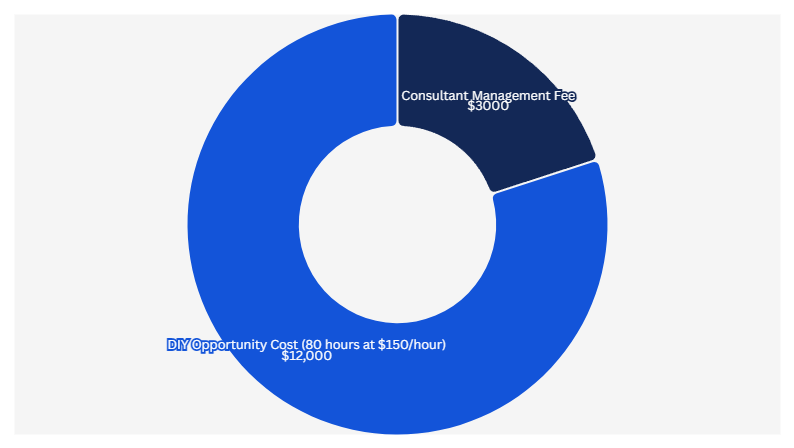
Consultant fee: $3,000 monthly (15% of spend)
DIY time requirement: 15-20 hours weekly
Founder opportunity cost: $150/hour × 80 hours monthly = $12,000
Pure economics favor consultant:
$3,000 consultant fee vs. $12,000 founder time value
Net savings: $9,000 monthly even assuming equal performance
But consultant typically delivers better performance through specialization
Consultant advantages at scale:
Daily optimization (bid adjustments 2-3x daily based on performance)
Platform beta access (early feature testing)
Advanced attribution (multi-touch modeling, CRM integration)
Competitive intelligence (cross-client benchmarking)
Research demonstrates teams testing 10+ A/B variations achieve 86% better conversion results. At $15,000+ monthly spend, testing velocity consultant enables justifies management fee through performance improvement alone.
The Complexity Threshold: When Product Difficulty Demands Expertise
Ad spend alone doesn't determine hire vs. DIY. Product and sales complexity create expertise requirements:
Simple Product + Short Sales Cycle = DIY Viable
Product characteristics:
Single SKU or limited catalog
Clear value proposition (solves obvious problem)
Self-service purchase (no sales calls required)
Price point under $200
Immediate value delivery
Example: Ecommerce store selling phone cases
30 SKUs, prices $25-45, customer researches 1-2 days, purchases directly, receives product within week
DIY campaign simplicity:
Targeting: Broad match keywords (phone cases, iPhone 14 case, protective case)
Ad creative: Product photos, clear pricing, shipping details
Landing page: Product page with add-to-cart
Attribution: Last-click conversion tracking sufficient
Optimization: Weekly bid adjustments, monthly keyword pruning
Founder can manage because:
Customer journey straightforward (search, click, buy)
No multi-touch attribution complexity
Campaign structure simple (10-15 ad groups maximum)
Creative needs basic (product photography)
Complex Product + Long Sales Cycle = Consultant Necessary
Product characteristics:
Custom configuration or enterprise solution
Requires education (buyer researches 3-6 months)
Sales-assisted close (demo calls, proposals)
Price point $5,000-500,000+
Implementation timeline weeks-months
Example: B2B SaaS for enterprise resource planning
Custom pricing, 4-8 stakeholder buying committee, 6-month consideration cycle, $50,000-200,000 annual contract value
Campaign complexity:
Targeting: Job title, company size, industry, tech stack signals
Ad creative: Thought leadership, ROI calculators, comparison content
Landing pages: Multi-step education (awareness, consideration, decision content)
Attribution: Multi-touch (assisted conversions, view-through, offline conversion import)
Optimization: Daily based on CRM pipeline data
Consultant required because:
Attribution complexity (tracking 6-month journey across 8-12 touchpoints)
CRM integration (syncing ad clicks with sales pipeline stages)
Content strategy (producing educational assets for each buying stage)
Negative keyword sophistication (filtering 90% of searches as unqualified)
Founder cannot DIY without:
40+ hours monthly time investment
Advanced platform knowledge (custom audiences, offline conversion tracking)
CRM technical integration skills
Multi-touch attribution modeling expertise
The Signal: When DIY Performance Plateaus
Three performance indicators reveal DIY approach hitting limits:
Signal 1: Quality Score Stagnating Below 7
Quality Score components:
Expected CTR (predicted click rate based on keywords, ads, landing pages)
Ad relevance (how closely ad matches search intent)
Landing page experience (relevance, load time, mobile optimization)
DIY Quality Score plateau: 4-6 range (indicating structural problems)
Common DIY mistakes causing low scores:
Broad match keywords triggering irrelevant searches
Generic ad creative not matching specific search intent
Landing page generic (homepage vs. targeted landing page)
Mobile experience poor (slow load, difficult navigation)
Consultant correction:
Keyword refinement (removing broad match, adding negative keywords)
Ad copy specificity (dynamic keyword insertion, search-intent matching)
Landing page optimization (dedicated pages per ad group)
Mobile experience improvement (reducing load time, simplifying forms)
Quality Score improvement value: Moving from score 5 to 8 reduces CPC 20-30% while improving ad position. At $15,000 monthly spend, 25% CPC reduction saves $3,750 monthly, exceeding typical $2,250 consultant fee.
Signal 2: Testing Velocity Under 2 Tests Monthly
Effective PPC requires systematic testing:
Ad headline variations (testing 3-5 headlines per ad group monthly)
Landing page elements (CTA placement, form length, trust signals)
Audience segments (testing different demographic/interest combinations)
Bid strategies (testing manual vs. automated bidding)
Research shows teams testing 10+ variations achieve 86% better results. DIY managers typically test 0-2 variations monthly due to time constraints.
DIY testing limitation symptoms:
Same ad creative running 3+ months unchanged
No landing page A/B tests in 90 days
Bid strategy set once, never revisited
Audience targeting unchanged since campaign launch
Consultant testing velocity:
2-4 ad creative tests per ad group monthly
Weekly landing page element tests
Monthly audience segment experiments
Quarterly bid strategy evaluation
Testing velocity value: Consultant running 12 tests monthly vs. DIY 1-2 tests identifies winning variations 6x faster, compounding performance improvements over time.
Signal 3: CPA Increasing Despite Stable Conversion Rate
Symptom pattern:
Conversion rate stable at 2.8%
But CPA rising from $180 to $240 over 6 months
Indicating increasing competition, not landing page problems
Root cause: Competition increasing bids, platform costs rising, DIY approach not adjusting strategy
DIY limitation: Reactive optimization (adjusting bids after CPA increases) vs. proactive strategy (anticipating competitive changes)
Consultant strategic response:
Competitive intelligence (monitoring competitor ad copy, offers, positioning)
Bid strategy evolution (shifting to automated bidding when cost-effective)
Audience expansion (testing new segments before current audiences saturate)
Creative differentiation (developing unique angles competitors haven't tested)
Value of proactive strategy: Consultant anticipating market changes adjusts before performance degrades. DIY reactive approach responds after 2-3 months of degraded performance, losing $10,000-30,000 in wasted spend.
The Founder Time Value Calculation
True DIY cost includes opportunity cost of founder time:
Low-Value Founder Time = DIY Makes Sense
Scenario: Founder in early product validation phase
Billable rate: Not yet generating revenue
Alternative use of time: Product iteration, customer research
PPC time investment: 10 hours weekly learning and optimizing
Opportunity cost: $0 (no higher-value alternative work available)
Learning value: Platform knowledge becomes long-term asset
Decision: DIY justified even if consultant would perform 30% better
DIY makes sense when:
Founder has available time (not revenue-generating work queued)
Learning PPC skills provides strategic knowledge
Ad spend under $10,000 monthly (consultant fee percentage high)
Product requires frequent campaign adjustments (founder product knowledge valuable)
High-Value Founder Time = Consultant Justified
Scenario: Founder closing enterprise sales
Billable rate: $300-500/hour equivalent (closing $100,000-500,000 deals)
Alternative use of time: Sales calls, product strategy, fundraising
PPC time investment: 10 hours weekly = $12,000-20,000 monthly opportunity cost
Opportunity cost: $12,000-20,000 monthly
Consultant fee: $2,000-4,000 monthly (15% of $13,000-27,000 spend)
Decision: Consultant justified purely on opportunity cost, even assuming equal performance
Consultant necessary when:
Founder time worth $200+/hour on other activities
Revenue-generating work queued (sales calls, client delivery)
Strategic initiatives delayed (product roadmap, fundraising)
PPC management preventing higher-value work
Break-Even Founder Time Value
Calculation:
Consultant fee: $2,000 monthly (managing $13,000 spend)
DIY time requirement: 10 hours monthly (after learning curve)
Break-even founder value: $2,000 ÷ 10 hours = $200/hour
Decision rule:
Founder time value >$200/hour → Hire consultant
Founder time value <$200/hour → DIY viable
Founder time value ~$200/hour → Evaluate other factors (complexity, growth, testing needs)
The DIY-to-Consultant Transition Playbook
Most companies start DIY, transition to consultant as complexity grows:
Phase 1: DIY Learning Period (Months 1-6)
Appropriate when:
Ad spend $3,000-8,000 monthly
Single product or simple catalog
Founder has 10-15 hours weekly available
Learning curve acceptable (suboptimal performance expected)
DIY focus areas:
Platform fundamentals (campaign structure, keyword research, ad creation)
Conversion tracking (ensuring accurate data collection)
Basic optimization (pausing underperforming keywords, adjusting bids)
Landing page basics (clear value proposition, simple CTA)
Performance expectations:
Months 1-3: 1.5-2.5 ROAS (learning phase)
Months 4-6: 2.5-3.5 ROAS (competent execution)
Acceptable given zero consultant fees and learning value
Transition signals (indicating Phase 2 readiness):
Ad spend growing to $10,000+ monthly
Time investment exceeding 15 hours weekly
Performance plateauing despite optimization efforts
Founder time becoming bottleneck for other growth initiatives
Phase 2: Consultant Engagement (Months 7-12)
Transition approach:
Month 1: Consultant audit (identifying quick wins, establishing baseline)
Month 2: Implementation (restructuring campaigns based on consultant recommendations)
Month 3: Optimization (consultant takes over daily management, founder monitors weekly)
Consultant handoff:
Platform access (granting consultant admin access to ad accounts)
Knowledge transfer (sharing product positioning, customer insights, conversion goals)
Reporting cadence (weekly performance reports, monthly strategy calls)
Performance benchmarks (agreeing on target ROAS, CPA, or revenue goals)
Expected improvements:
Months 7-9: 3.5-4.5 ROAS (consultant optimization)
Months 10-12: 4.5-6.0 ROAS (consultant full optimization)
Improvement typically 30-60% over DIY performance
ROI validation:
Consultant fee: $1,500-3,000 monthly
Revenue improvement: $15,000-40,000 monthly (at 40-60% performance increase)
Net benefit: $12,000-37,000 monthly even after consultant fees
Phase 3: In-House vs. Consultant Decision (Month 12+)
If ad spend reaches $50,000+ monthly consistently:
Consider in-house PPC manager ($90,000-120,000 annually)
Consultant at 12% = $72,000 annually
In-house provides daily optimization, product knowledge depth
See "Pay Per Click Consultant vs. In-House PPC Manager" analysis for full comparison
If ad spend remains $15,000-50,000 monthly:
Consultant model typically optimal
Provides expertise without full-time salary
Flexibility to scale up/down based on performance
Access to platform relationships and cross-client insights
When DIY Makes Sense Long-Term
Some businesses should remain DIY permanently:
Scenario 1: Micro-Spend with Complex Attribution Needs
Example: Local service business
Ad spend: $2,000 monthly
Average sale: $8,000
Sales cycle: 30-90 days (phone consultations, site visits, proposals)
Why consultant doesn't work:
$300 consultant fee (15% of $2,000) insufficient to justify consultant attention
Attribution complexity (offline conversions, multi-touch journey) requires custom setup
Small account volume makes most consultants unprofitable
Why DIY works:
Founder understands sales process intimately
Can track offline conversions manually (recording which leads came from ads)
Low spend means mistakes cost less
Campaign simplicity (local targeting, 5-10 keywords)
Scenario 2: Rapid Product Evolution Requiring Daily Campaign Adjustments
Example: Early-stage SaaS during product-market fit search
Product: Iterating weekly based on user feedback
Messaging: Changing as positioning evolves
Targeting: Experimenting with different customer segments
Why consultant struggles:
Weekly product changes require constant campaign restructuring
Consultant working across multiple clients cannot provide daily adjustments
Consultant lacks real-time product knowledge to adjust messaging
Why founder DIY works:
Immediate campaign updates as product evolves
Messaging reflects current product positioning
Testing different customer segments aligned with product experiments
No communication lag (founder knows product changes instantly)
Scenario 3: Strategic Learning Priority
Example: Marketing leader building team
Goal: Learn PPC to manage future in-house team or consultant effectively
Time horizon: 6-12 months investment acceptable
Budget: $5,000-15,000 monthly for learning
Why DIY makes sense temporarily:
Platform knowledge enables better future hiring decisions
Understanding mechanics prevents consultant dependency
Learning cost justified by long-term strategic value
Can transition to consultant/in-house after knowledge baseline established
How BluePing Reveals Whether PPC Problems Are Campaign or Landing Page Issues
BluePing diagnostic distinguishes between campaign management problems (consultant helps) vs. landing page friction (consultant cannot fix):
Diagnostic Scenario 1: Campaign Problem, Landing Page Fine
PPC metrics: 1.4% CTR, $6.80 CPC, Quality Score 4/10
Landing page metrics: 2.9% conversion rate when traffic arrives, 28% bounce rate
BluePing diagnosis: Campaign targeting poor (low CTR, high CPC, low Quality Score), but landing page converts well when qualified traffic reaches it
Implication: Consultant or improved DIY campaign management needed. Landing page not the problem. Hiring consultant improves targeting, reduces CPC, increases Quality Score.
Diagnostic Scenario 2: Campaign Fine, Landing Page Problem
PPC metrics: 4.2% CTR, $2.90 CPC, Quality Score 8/10
Landing page metrics: 1.1% conversion rate, 68% bounce rate
BluePing diagnosis: Campaign management strong (good CTR, low CPC, high Quality Score) but landing page friction destroying conversions
BluePing specific friction identified:
Mobile load time 7.2 seconds (research shows 53% abandon sites loading over 3 seconds)
Form requires 11 fields (research shows reducing to 4 increases conversions 120%)
CTA below fold on mobile (82.9% of traffic per industry research)
No trust signals above fold
Implication: Consultant vs. DIY debate irrelevant. Campaign performing well. Fix landing page friction first, then re-evaluate whether conversion rates justify current management approach.
Diagnostic Scenario 3: Both Problems Present
PPC metrics: 2.1% CTR, $5.20 CPC, Quality Score 5/10
Landing page metrics: 1.6% conversion rate, 54% bounce rate
BluePing diagnosis: Both campaign management suboptimal AND landing page friction present
Prioritization logic:
Fix landing page friction first (immediate impact, no ongoing cost)
Then hire consultant or improve DIY campaign management
Combined approach delivers compounding improvements
Example outcome:
Landing page fixes: 1.6% to 3.2% conversion rate (100% improvement)
Consultant campaign optimization: 2.1% to 3.8% CTR, $5.20 to $3.40 CPC
Combined result: 2x conversion rate + 35% CPC reduction = 3.1x ROI improvement
The hire vs. DIY decision follows spend-based economics (consultant justified above $15,000 monthly), complexity thresholds (long sales cycles demand expertise), and founder time value (consultant makes sense when opportunity cost exceeds 15% management fee). DIY works permanently for micro-budgets under $5,000, rapidly evolving products requiring daily adjustments, and strategic learning investments. Three signals indicate DIY limits: Quality Score below 7, testing velocity under 2 monthly tests, and rising CPA despite stable conversion rates. BluePing reveals whether performance problems stem from campaign management (consultant helps) or landing page friction (consultant cannot fix), enabling proper prioritization

.png)
.png)