

.png)
Eighteen months into content strategy: 127 published blog posts, 45,000 monthly organic visitors, 850 trial signups per month from search traffic. Marketing dashboard shows keyword rankings climbing (23 position-one rankings, 67 top-three positions), domain authority increasing (DR 42 to DR 58), and organic traffic growing 28% quarter-over-quarter.
Trial-to-paid conversion rate stuck at 2.8%. Revenue per organic visitor declining month-over-month. Customer acquisition cost from SEO increasing despite traffic growth because trial signups don't convert to paid accounts at rates justifying content investment.
The diagnostic gap: Team optimized content for search rankings (keyword targeting, technical SEO, backlink acquisition) but ignored post-signup conversion architecture. According to research from OpenView Partners analyzing 400+ SaaS companies, product-led growth companies achieve 30-50% higher trial-to-paid conversion rates than sales-led companies because PLG products self-demonstrate value during trial periods while SEO-acquired users often lack activation context.
SaaS SEO driving trial volume without activation mechanics encounters predictable failure: Users discover product through content addressing specific pain points but trial experience doesn't connect search intent to product capability. Search query "project management for remote teams" attracts qualified visitor but trial onboarding flow designed for general project management fails to address remote-specific use cases searcher expected.
Product-led growth optimizing viral distribution without search visibility limits addressable market to users already aware of problem and actively seeking solutions through peer networks. SEO attracts problem-unaware prospects discovering solutions through informational search while PLG depends on problem-aware users sharing product within existing networks.
SaaS companies choosing between SEO and PLG strategies determine growth velocity, customer acquisition economics, and product development priorities. The decision affects whether trial signups come from content discovery or user referrals, and whether activation depends on onboarding optimization or product self-service.
"Strategy is about making choices, trade-offs; it's about deliberately choosing to be different." — Michael Porter
Why SaaS SEO and Product-Led Growth Drive Different Trial Quality
SaaS SEO and product-led growth generate trial signups through fundamentally different discovery mechanisms creating distinct user expectations and activation requirements.
SaaS SEO acquisition path:
- User searches problem-related query ("how to track remote team productivity")
- Discovers educational content ranking for query
- Content addresses pain point and introduces product as solution
- User clicks trial CTA from blog post
- Trial signup occurs with educational context (problem → solution → product)
Product-led growth acquisition path:
- User receives product invitation from colleague/peer
- Invitation includes specific use case context (workspace share, project collaboration invite)
- User experiences product value before formal signup (preview access, limited feature trial)
- Signup occurs after initial value demonstration
- Trial continues with peer-validated use case
The acquisition path difference determines trial quality and conversion likelihood. Research from Pacific Crest analyzing SaaS trial conversion rates found that referred users convert to paid at 3-4x higher rates than content-acquired users because referral includes implicit product validation and use case alignment.
SEO-acquired trials enter product without peer validation or demonstrated proof. User clicked trial CTA based on content promise ("this tool helps remote teams") but hasn't seen product deliver value. Trial period becomes proof-of-concept rather than expansion of demonstrated value.
PLG-acquired trials enter product with peer recommendation and preview experience. User already witnessed colleague deriving value and received invitation to specific workspace/project. Trial period extends existing value rather than establishing initial proof.
The trial quality gap explains why identical products achieve different conversion rates through different acquisition channels. Product optimized for PLG (instant value demonstration, viral sharing mechanics) converts trials at 15-25% while same product acquired through SEO converts at 3-8% because SEO users require activation assistance PLG users received through peer onboarding.
When SaaS SEO Outperforms Product-Led Growth
SaaS SEO delivers superior trial volume and customer acquisition economics when target customers discover solutions through search rather than peer networks and when product complexity requires educational context before trial.
Scenario 1: Problem-Unaware Market with High Search Volume
Market characteristics:
- Customers experience pain but don't know solutions exist
- High monthly search volume for problem-related queries (5,000+ searches)
- Low existing product awareness in target market
- Educational gap between problem recognition and solution discovery
Example: Marketing attribution software for B2B SaaS companies
Search behavior:
- "how to track which channels drive trial signups" (1,200 monthly searches)
- "measure marketing roi for saas" (800 monthly searches)
- "connect marketing to revenue" (600 monthly searches)
Why SEO wins: Target customers search for problem-related information before discovering attribution software category exists. SEO content educates market while positioning product as solution. PLG requires existing awareness and peer networks SaaS attribution market lacks.
Conversion impact: Research from Wynter analyzing B2B SaaS messaging shows 68% of buyers discover new software categories through search rather than peer recommendations when solving novel problems. SEO captures this discovery traffic PLG misses.
Scenario 2: Complex Products Requiring Setup Context
Product characteristics:
- Multi-step configuration required before value demonstration
- Product solves sophisticated workflow problems
- Trial success depends on proper initial setup
- Feature depth creates learning curve
Example: API monitoring and observability platforms
Why SEO wins: Educational content provides implementation context trial users need. Blog posts explain setup requirements, common configuration mistakes, and expected value realization timeline. Users entering trial through SEO arrive with realistic expectations and setup guidance.
PLG limitation: Peer invitations provide limited context for complex setup. Invited users expect instant value (PLG promise) but complex products require configuration before demonstrating capability. Expectation mismatch drives trial abandonment.
Data evidence: According to Appcues research on SaaS onboarding, products requiring 5+ setup steps achieve 40-60% lower trial activation when users lack implementation guidance. SEO content provides this context while PLG invitations typically don't.
Scenario 3: Long Sales Cycles with Research-Driven Buyers
Buyer characteristics:
- Decision requires stakeholder buy-in and budget approval
- 3-6 month evaluation period before purchase
- Buyers conduct extensive research comparing solutions
- Purchase decision involves multiple evaluation criteria
Example: Enterprise resource planning (ERP) systems, compliance software
Why SEO wins: Content strategy supports extended research cycles by providing solution education at multiple buying stages. Comparison guides, implementation case studies, and ROI calculators align with research-driven evaluation process.
Conversion timeline: Research from Gartner found B2B buyers spend 27% of purchase journey conducting independent research through search. SEO captures this research traffic throughout extended buying cycle while PLG depends on viral adoption unsuited to committee-driven purchases.
When Product-Led Growth Outperforms SaaS SEO
Product-led growth achieves faster trial signup velocity and higher conversion rates when products deliver immediate value, target users discover solutions through peer networks, and viral mechanics accelerate distribution.
Scenario 1: Instant Value Demonstration Products
Product characteristics:
- Value visible within 60 seconds of signup
- No setup or configuration required
- Single-user utility before team collaboration
- Immediate problem resolution
Example: Screen recording tools, quick prototyping software, simple scheduling tools
Why PLG wins: Users experience value before formal trial period begins. Product demonstrates capability immediately and viral sharing occurs naturally when users send recordings, share prototypes, or book meetings. Each product use generates new user acquisition.
SEO limitation: Content-driven acquisition requires 3-5 touchpoints before trial signup. User discovers content, reads educational material, returns for product comparison, then initiates trial. PLG compresses this to single interaction through peer sharing.
Growth velocity: According to OpenView Partners research, PLG companies grow 2-3x faster than sales-led companies in categories where product demonstrates value instantly. Viral coefficient above 1.0 (each user brings 1+ new users) creates exponential growth SEO can't match.
Scenario 2: Network Effect Products
Product characteristics:
- Product value increases with user count
- Collaboration features drive core functionality
- User invitations built into product workflow
- Multiplayer experience central to value proposition
Example: Design collaboration tools (Figma), project management with team features (Notion), communication platforms (Slack)
Why PLG wins: Product usage generates user invitations naturally. Designer shares Figma file with stakeholder, stakeholder needs Figma account to view/comment, new signup occurs through product use. Network effects create viral acquisition loop.
Viral mechanics: Research from NFX analyzing network effects shows products with built-in sharing achieve CAC 60-80% lower than content-driven acquisition because each paying customer recruits multiple new users through product use.
SEO comparison: Content can drive initial awareness but can't replicate viral distribution mechanics. Blog post about "design collaboration best practices" attracts 1,000 visitors but generates 20 trials. PLG product use where designer shares file with 5 teammates generates 5 trials from single user action.
Scenario 3: Consumer and SMB Markets with Peer Recommendation Behavior
Market characteristics:
- Buyers trust peer recommendations over vendor content
- Purchase decisions influenced by existing user testimonials
- Low-risk trial signup (no sales interaction required)
- Community-driven discovery common
Example: Marketing automation for small businesses, creator economy tools, freelancer software
Why PLG wins: Target market discovers tools through peer communities, social media sharing, and word-of-mouth rather than search. Product trials occur after seeing peers demonstrate results. Social proof drives conversion more than educational content.
Conversion data: Research from SaaStr analyzing SMB SaaS adoption found peer recommendations drive 3.2x higher trial-to-paid conversion than content marketing in SMB segment because recommendation includes implicit solution validation.
The SaaS SEO Plus PLG Hybrid Strategy
High-performing SaaS companies combine SEO content strategy with product-led growth mechanics rather than choosing exclusively between approaches. Hybrid strategy uses SEO to drive discovery and initial trial volume while implementing PLG features to optimize trial conversion and enable viral distribution.
Hybrid implementation:
Phase 1: SEO drives awareness and trial signups
- Content strategy targets problem-aware and problem-unaware search queries
- Educational content ranks for high-intent keywords attracting qualified visitors
- Blog posts include product CTAs converting readers to trial users
- SEO generates consistent monthly trial volume independent of sales team
Phase 2: PLG mechanics optimize trial activation
- Onboarding flows provide instant value demonstration within trial period
- Product includes viral sharing features (invite teammates, share workspaces, collaborate on projects)
- Trial users experience value before sales conversation required
- Product usage generates peer invitations expanding trial volume beyond SEO acquisition
Phase 3: SEO content supports PLG viral loops
- Use case guides help trial users activate specific features
- Implementation templates accelerate time-to-value
- Comparison content supports evaluation process for referred users
- Educational material shared by existing users to justify product recommendations
Performance data: According to Battery Ventures research on SaaS growth strategies, companies combining SEO and PLG achieve 40% higher trial volume than SEO-only approaches and 35% higher trial-to-paid conversion than PLG-only products because SEO fills top-of-funnel while PLG optimizes conversion and enables viral growth.
Example hybrid execution:
Company targets "project management for agencies" (4,300 monthly searches). SEO content ranks for query attracting 1,200 monthly organic visitors generating 80 trial signups. PLG mechanics within product allow trial users to invite team members to projects. Each trial user invites average 2.3 additional users. Original 80 SEO-driven trials generate 184 additional trials through product sharing. Combined acquisition: 264 monthly trials (80 SEO direct + 184 PLG viral) from single channel investment.
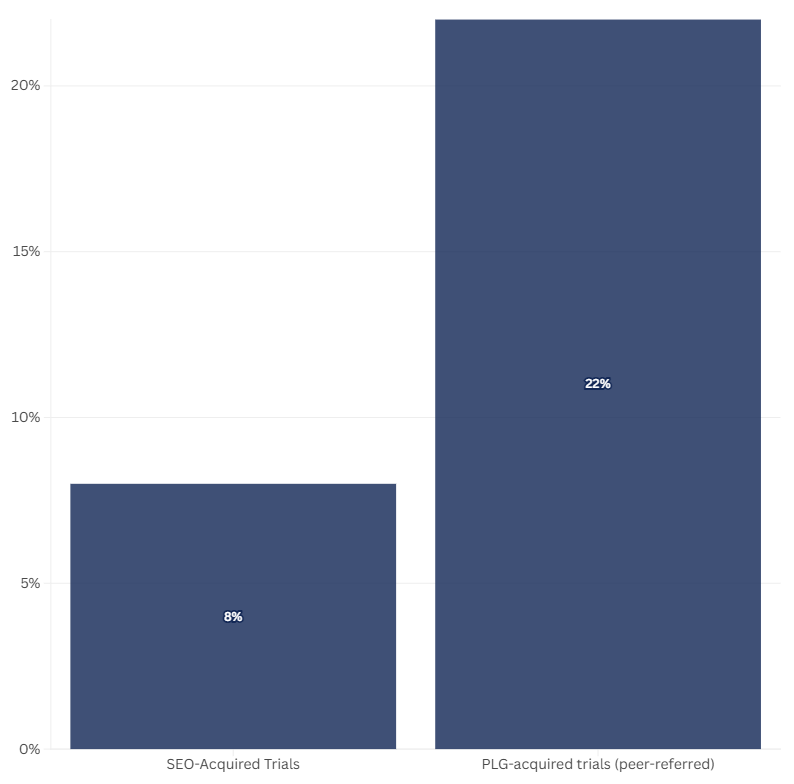
Trial-to-paid conversion: SEO-acquired users convert at 8% (industry benchmark for content-driven trials). PLG-invited users convert at 22% (peer validation effect). Blended conversion: (80 × 0.08) + (184 × 0.22) = 46.88 paid conversions from 264 trials = 17.8% overall conversion rate.
Hybrid approach generated 2.9x paid customers compared to SEO-only strategy at similar content investment because PLG mechanics multiplied trial volume and improved conversion rates.
How to Choose Between SaaS SEO and Product-Led Growth
Decision framework for channel prioritization based on product characteristics, market dynamics, and resource constraints:
Choose SaaS SEO when:
- Target customers search for solutions: Monthly search volume for problem-related queries exceeds 2,000 searches and growing
- Product requires education before trial: Complex setup, multi-step configuration, or sophisticated features benefit from implementation guidance
- Long sales cycles justify content investment: B2B enterprise sales with 3-6 month evaluation periods reward educational content throughout buying journey
- Low existing product awareness: New category or novel solution approach where peer networks haven't yet adopted product
- Content creation capability available: Team can produce 8-12 high-quality blog posts monthly targeting buyer journey stages
Resource requirement: 12-18 months before SEO generates meaningful trial volume. Expect 6-9 months reaching first-page rankings and additional 6-9 months building domain authority supporting competitive keyword rankings.
Choose product-led growth when:
- Product demonstrates value instantly: Users experience clear benefit within 60 seconds without setup or configuration
- Viral mechanics built into core workflow: Product use naturally generates new user invitations through sharing, collaboration, or multiplayer features
- Target market discovers through peer networks: Community-driven adoption or social proof drives purchase decisions more than educational content
- Network effects drive product value: Product improves with additional users creating natural incentive for existing users to recruit peers
- Self-service trial converts without sales interaction: Product onboarding guides users to value realization independently
Resource requirement: Product development investment creating instant value demonstration and viral sharing features. Expect 3-6 months implementing PLG mechanics and 6-12 months optimizing trial conversion rates.
Implement hybrid approach when:
- Both search volume and viral potential exist: Market searches for solutions AND product enables natural sharing
- Content supports viral distribution: Educational material trial users share to justify product recommendations to peers
- Resources support both investments: Team can maintain content production while developing PLG product features
- Trial volume and conversion both need optimization: SEO alone generates insufficient trials while PLG alone limits addressable market
Why Traffic Growth Without Conversion Architecture Wastes SEO Investment
SaaS SEO generating trial signups without conversion optimization encounters predictable failure pattern: Increasing organic traffic and trial volume while trial-to-paid conversion remains flat or declining. Content investment delivers visitor growth but revenue per visitor decreases because post-trial conversion issues remain unaddressed.
Common scenario: Company publishes 15 blog posts monthly targeting "project management for remote teams" keyword cluster. Six months later organic traffic increases from 5,000 to 28,000 monthly visitors. Trial signups grow from 120 to 680 per month. Trial-to-paid conversion rate: 2.1% before content strategy, 1.8% after implementation. Despite 5.6x trial growth, paid customer acquisition increased only 5.1x while content costs increased 6x (additional writers, SEO tools, content management overhead).
The conversion gap: SEO optimized content for search rankings but trial signup experience ignored conversion barriers. Trial onboarding flow requiring 12 information fields, lacking industry-specific onboarding paths, and presenting generic feature tour lost 82% of qualified trial users before value demonstration. Search query intent ("project management for remote teams") attracted specific use case but trial experience addressed generic project management without remote team features highlighted.
Research from ProfitWell analyzing SaaS trial conversion found trial-to-paid rates vary 200-400% based on onboarding quality even when trial signups come from identical traffic sources. SEO drives qualified visitors but conversion architecture determines whether trials convert to revenue.
Conversion barriers SEO can't detect or fix:
Form friction in trial signup: Trial signup requiring 12 fields (email, password, full name, company name, company size, role, phone number, industry, use case, team size, current tools, referral source) versus simplified 3-field signup (email, password, company name). Research demonstrates each additional form field reduces completion rate 5-10%. Trial signup with 12 fields loses 45-60% of visitors who clicked signup CTA from SEO content.
Missing activation context for search intent: User discovered product through blog post "how to manage remote team projects across time zones" but trial onboarding presents generic feature walkthrough without addressing timezone collaboration features searcher expected. Intent mismatch drives trial abandonment because product demonstration doesn't connect to search motivation.
Mobile trial experience friction: 78% of trial signups occur on mobile devices but trial onboarding optimized for desktop. Mobile users encounter tap targets smaller than 44×44 pixels (industry minimum), horizontal scrolling on configuration screens, and forms requiring desktop keyboard for efficient completion. Mobile conversion rate: 1.2% versus desktop 4.8%. SEO content drives mobile traffic but mobile trial experience wastes acquisition investment.
Trust signal gaps during trial evaluation: Trial period requires credit card immediately despite "14-day free trial" messaging. No visible security badges, customer testimonials, or company information during signup. Unclear cancellation policy and missing trial-to-paid transition explanation. Trust barriers drive trial abandonment independent of product quality.
How BluePing Reveals Conversion Barriers SEO Can't Measure
SaaS SEO optimizes content for search visibility and trial signup volume. BluePing scans trial signup pages and onboarding flows revealing specific conversion barriers preventing trial-to-paid conversion.
What SEO tools measure:
- Keyword rankings and search visibility
- Organic traffic volume and growth trends
- Content performance and engagement metrics
- Backlink acquisition and domain authority
What SEO tools miss:
- Trial signup form friction (field count, required information)
- Trust signal positioning relative to signup CTA
- Mobile trial experience quality (tap targets, scrolling, form usability)
- Onboarding flow alignment with search intent
- Trial-to-paid conversion barriers
BluePing diagnostic scans trial pages in ~30 seconds identifying:
Form complexity blocking qualified trials: Counts required form fields, identifies unnecessary information requests, flags excessive signup friction. Benchmark: 3-4 fields for low-touch SaaS, 5-6 fields maximum for enterprise products requiring lead qualification.
Trust signal gaps reducing conversion confidence: Verifies security badges, customer testimonials, and company credibility signals appear within one screen of trial signup CTA. Missing trust elements visible before form submission reduce conversion 18-42%.
Mobile experience friction: Tests mobile viewport detecting tap targets below 44×44 pixels, horizontal scrolling requirements, form fields requiring desktop optimization. Mobile-specific barriers lose 40-60% of mobile trial traffic.
Trial-to-paid transition clarity: Identifies missing information about trial period length, automatic billing triggers, cancellation process, and upgrade path. Unclear trial mechanics drive abandonment from qualified users concerned about unexpected charges.
SaaS companies investing $50,000-$200,000 annually in SEO content strategy driving 5,000+ monthly trial signups but converting trials at 2-4% face conversion architecture problems SEO optimization can't solve. BluePing reveals why search-qualified visitors don't complete trials and identifies specific fixes improving trial-to-paid conversion 35-120%.
SaaS SEO and product-led growth drive trial signups through different discovery mechanisms creating distinct conversion requirements. SEO captures search-driven discovery generating consistent trial volume over 12-18 months while PLG enables viral distribution through peer sharing and instant value demonstration. Optimal strategy depends on product complexity, market search behavior, and whether target customers discover solutions through content or peer networks. But trial volume from either channel wastes acquisition investment when trial signup flows contain form friction, trust signal gaps, or mobile experience barriers that prevent conversion regardless of traffic source. BluePing scans trial pages in ~30 seconds revealing specific conversion barriers SEO tools can't measure and PLG metrics don't detect.
.png)
.png)
.png)