

.png)
You have heard the term enough times that it feels like something you should already be doing. Conversion rate optimisation specialist. Maybe someone on your team mentioned it. Maybe you searched it after a quarter of flat revenue despite growing traffic. Maybe you are trying to figure out whether you need one, what they actually do all day, and whether the investment makes sense for where your business is right now.
Most content on this topic answers only one of those questions and buries it in job description language. This piece answers all of them, starting with the part nobody explains clearly enough.
What a CRO Specialist Actually Does
The job title is straightforward. The actual work is not.
A conversion rate optimisation specialist is responsible for increasing the percentage of website visitors who complete a defined action, whether that is a purchase, a lead form submission, a trial sign-up, or any other goal the business has set. But that outcome description tells you almost nothing about how the work gets done.
In practice, a CRO specialist spends the majority of their time on three activities before a single test is ever run.
The first is research. This means pulling and segmenting analytics data, watching session recordings, analysing heatmaps, reviewing form abandonment data, and sometimes running user surveys or customer interviews to understand where and why visitors are dropping off. The research phase can take weeks on a complex site.
The second is hypothesis formation. Based on what the research surfaces, the specialist builds specific, testable hypotheses about what is causing conversion loss and what change would address it. This is not brainstorming. It is structured reasoning from evidence to a falsifiable prediction.
The third is test design and analysis. The specialist determines which pages have sufficient traffic to support statistically significant testing, designs the experiment, works with developers and designers to build variants, monitors the test, and interprets the results correctly, which means knowing when a result is signal and when it is noise.
As Michael Aagaard, Senior Conversion Optimizer at Unbounce, puts it: "CRO is all about optimizing decisions and actions — not web pages. The web page is just a tool that we can use to make more potential customers decide to carry out the desired action."
That distinction matters because it defines what a specialist is actually managing. They are not redesigning pages. They are systematically removing the obstacles that prevent a specific decision from being made.
The Skills That Separate Good From Great
A CRO specialist role touches more disciplines than most people expect when they hire for it. According to VWO, whose published research on hiring CRO specialists is among the most referenced in the industry, a strong specialist needs fluency across web analytics, user psychology, A/B testing methodology, copywriting, and the basics of front-end development, enough to collaborate with developers without being blocked by them.
The analytical layer is non-negotiable. A specialist who cannot correctly interpret statistical significance, identify confounding variables in test results, or segment data by device, traffic source, and funnel stage will produce unreliable conclusions regardless of how many tests they run.
The psychology layer is what separates the effective specialists from the technically proficient ones. Understanding why a visitor hesitates on a pricing page, what makes a form feel invasive, or which trust signals matter at which stage of a decision requires genuine interest in human behaviour, not just data literacy.
VWO's hiring guide captures this directly: "CROs are unicorns, not sea monkeys. You can't just add water and get the results you want." The point being that the combination of analytical rigour and behavioural intuition takes time to develop, and shortcuts in the hiring process typically produce disappointing results.
What a CRO Engagement Costs in 2025
This is where most businesses get surprised, because the range is wider than expected and the tiers represent genuinely different levels of capability.
According to Invesp, a specialised CRO agency with over a decade of documented client work, the pricing landscape in 2025 breaks down as follows. Top-tier dedicated CRO agencies with at least seven years of experience and strong track records start at $10,000 per month and commonly charge $16,000 to $30,000 per month. Mid-tier agencies with solid but less extensive track records charge $6,000 to $15,000 per month. Entry-level agencies newer to dedicated CRO work charge $2,000 to $5,000 per month.
Independent CRO consultants typically charge $150 to $500 per hour, according to ConversionTeam's 2025 pricing research, with engagement structures varying between project-based audits and ongoing retainers.
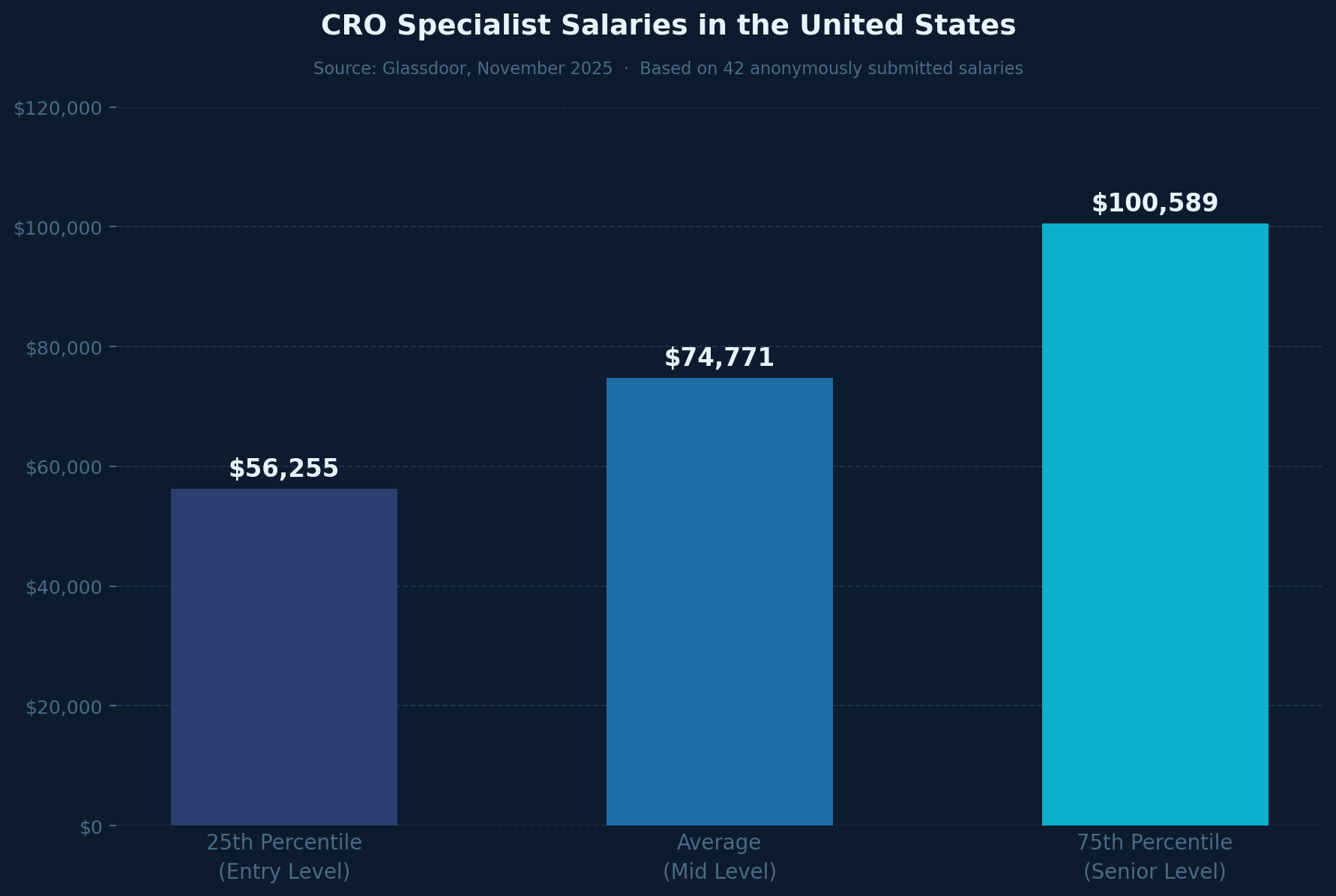
For in-house hiring, Glassdoor data based on 42 anonymously submitted US salaries as of November 2025 puts the average CRO specialist salary at $74,771 per year, with the range running from $56,255 at the 25th percentile to $100,589 at the 75th percentile. Senior and director-level roles can reach $120,000 to $180,000, reflecting the expanded responsibilities of managing a full optimisation programme.
The salary figure does not include the A/B testing platforms, heatmapping tools, session recording software, and analytics integrations a specialist needs to do the work, which Invesp estimates add $200 to $1,500 per month depending on traffic volume and tool stack.
The Signs Your Business Is Ready
A CRO specialist engagement makes business sense when three conditions are simultaneously true.
Traffic volume is sufficient for testing. Reaching 95% statistical confidence on an A/B test with a 10% minimum detectable effect requires roughly 1,000 conversions per variant. For a page converting at 2%, that means approximately 50,000 visits per variant before results are actionable. If your site is not generating that kind of traffic on the pages you want to optimise, a specialist will have limited ability to run valid tests and limited data to work from.
Revenue justifies the investment. A CRO agency engagement starting at $6,000 per month needs to generate at least that much in measurable lift to break even. According to Baymard Institute's checkout usability research, the average large e-commerce site can achieve a 35.26% increase in conversion rate through better checkout design alone. At that scale, the investment arithmetic is clear. At smaller revenue volumes, the same percentage improvement produces a smaller absolute return.
The conversion problem is specific, not general. A specialist is most effective when the evidence already points to a defined problem in a defined part of the funnel. If the business does not yet know where conversions are being lost, a specialist will spend their first weeks doing the diagnostic work that could have been done more cheaply beforehand.
The Signs You Are Not Ready Yet
These are the signals that hiring a specialist before addressing them will produce a disappointing return on the investment.
You do not have a measurement baseline. If you cannot currently report your conversion rate by funnel step, by device type, and by traffic source, a specialist will spend the first part of the engagement building the analytics foundation rather than optimising. That work has value but it is not the work most businesses are paying for.
Your traffic is below the testing threshold. Fewer than 10,000 monthly visits to the page you want to optimise makes statistically valid A/B testing impractical at the timescales most engagements operate on. The specialist's recommendations will be directional rather than validated, which is a different kind of value.
The conversion problem has not been diagnosed. If you know revenue is lower than it should be but do not know which stage of your funnel is responsible, the right investment is a diagnostic first. Bringing a specialist in to fix something before understanding what needs fixing extends the time to results and increases the total cost.
In-House, Agency, or Freelance
Each model has a different risk profile and a different fit depending on where a business is.
An in-house specialist makes sense when CRO is a continuous, ongoing programme rather than a periodic project. The advantage is deep institutional knowledge, full context on the product and customers, and the ability to run tests at higher velocity over time. The disadvantage is that internal specialists are subject to the familiarity problem, they stop seeing the site through a first-time visitor's eyes, and internal politics can slow down implementation of findings that challenge existing design or copy decisions.
Agency engagements make sense when the business needs a full team across strategy, analytics, design, and development without the overhead of hiring all of those roles independently. Agencies bring documented methodologies, cross-client pattern recognition, and the ability to start fast. The risk is that junior team members do much of the work while senior talent appears mainly during kickoffs and reporting.
Freelance specialists offer flexibility for project-based needs such as a focused audit, a specific test programme, or a period of intensive diagnostic work. The quality range is wider than with established agencies, making vetting more important.
Regardless of model, Invesp's research consistently shows that the minimum viable CRO engagement is three to six months. Shorter timelines rarely produce enough test cycles to generate reliable learnings, and the ramp-up costs of onboarding are too high to amortise across a single test.
Questions to Ask Before You Hire
These are the questions that reveal whether a specialist or agency is worth engaging, and whether your business is ready to get value from the engagement.
What does your diagnostic process look like before you design the first test? A strong specialist will describe a structured research phase. A weak one will talk about testing ideas they already have.
How do you determine what to test first? The answer should involve evidence from your analytics, not a generic hierarchy of page elements.
What testing platform do you recommend and why, given our traffic volume? Anyone who recommends the same tool for a 5,000-visit-per-month site and a 500,000-visit-per-month site has not thought carefully about testing capacity.
Can you share a case study where a test failed and what you learned from it? A specialist who has only run winning tests has not run enough tests. Failed tests are where the real learning happens, and a practitioner who cannot discuss them is not giving you an honest picture of how CRO actually works.
The Step That Should Come Before All of This
Most businesses that are evaluating whether to hire a CRO specialist are doing so because they sense something is wrong with their conversion rate but do not know specifically what. That gap, between sensing the problem and knowing the problem, is where the most common and expensive mistake happens.
Bringing in a specialist before the problem is diagnosed means paying specialist-level prices for diagnostic work. It extends the time to any meaningful optimisation. And it makes it harder to evaluate whether the specialist is performing well, because there is no clear baseline against which to measure their impact.
The right sequence is: diagnose first, then engage. Understanding specifically which pages are underperforming, which barrier types are present, and where in the funnel traffic is exiting gives a specialist a defined brief rather than an open-ended investigation. Engagements with a clear brief produce results faster and at lower total cost.
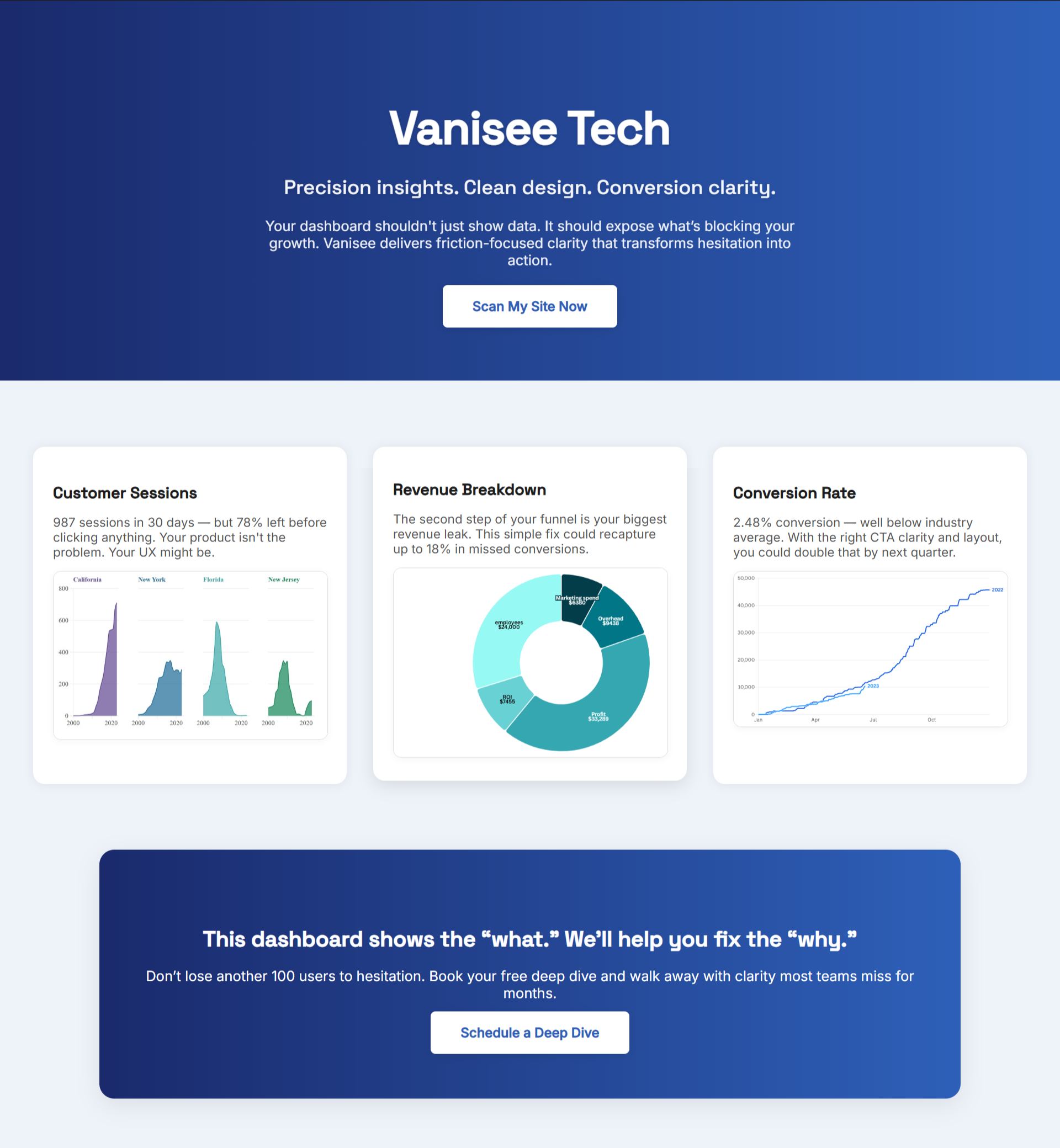
BluePing was built specifically for this diagnostic stage. It scans a page in approximately 30 seconds and evaluates it against a defined set of conversion criteria, surfacing the specific barriers present before any testing budget is allocated. At $395 as a one-time diagnostic, it is designed to answer the question of what to fix, so that the decision about whether and what kind of specialist to engage is made from evidence rather than intuition.
Conclusion
A conversion rate optimisation specialist is a valuable investment for businesses that have sufficient traffic, a clear sense of where their conversion problem is, and revenue to justify the engagement cost. For businesses earlier in that journey, the priority is building the diagnostic foundation that makes a specialist engagement worth having.
Understanding what these professionals actually do, what they cost, and what conditions need to be in place to extract value from the relationship is the starting point. The hiring decision follows from that, not the other way around.


.png)